
Your Room Is Part of the Sound
Before you change your system
When I design a loudspeaker, I think about the home it will eventually play in. A cabinet has defined dimensions. Your room brings its own walls, windows, furniture and favourite seat. They all become part of the listening experience.
My advice is to begin with what you can move. Sometimes the most useful adjustment is a different position for your chair.
You hear more than the speakers
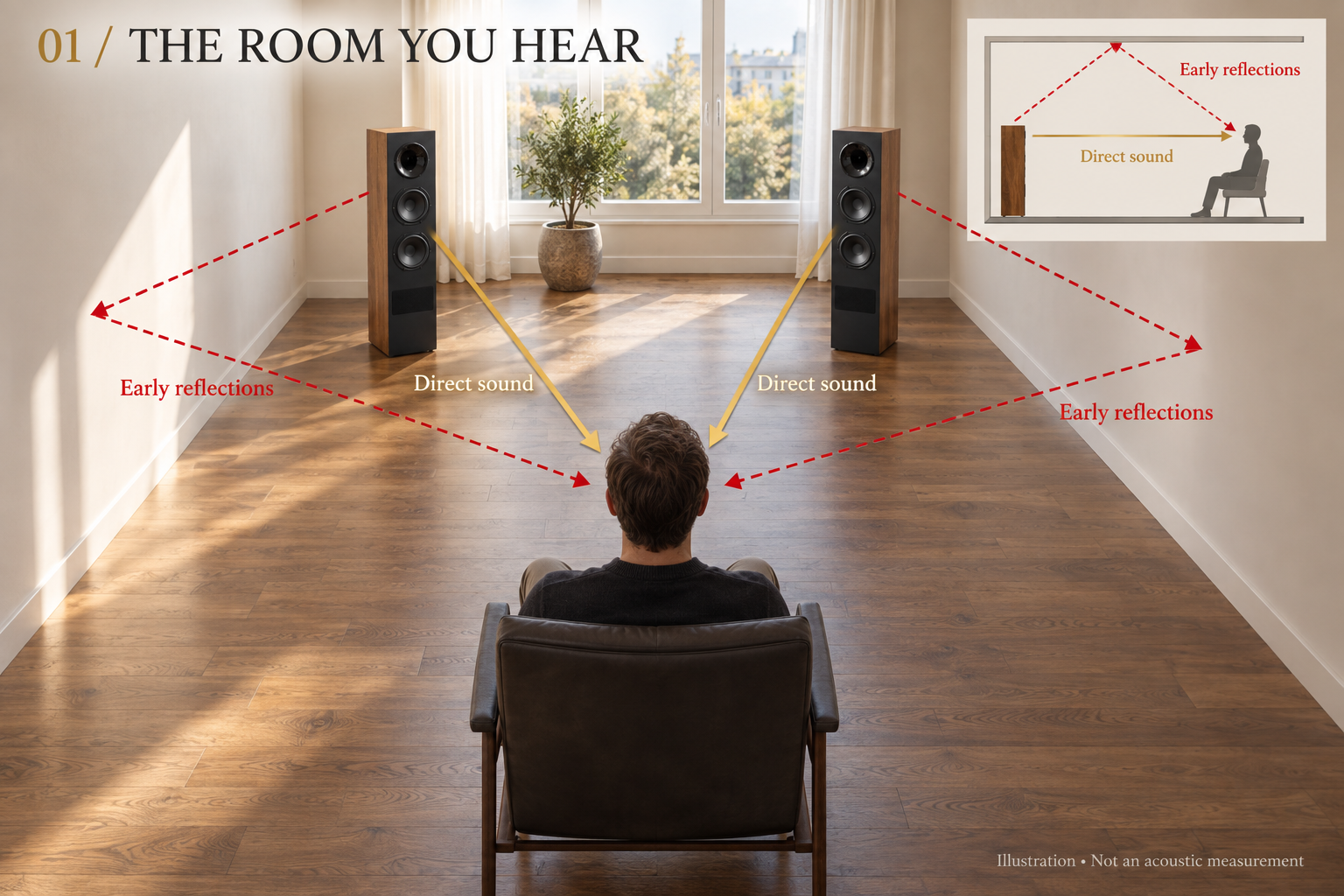
Some sound travels straight from each speaker to your ears. Other sound reaches you after meeting the floor, ceiling or walls. These arrivals overlap. Strong early reflections can change tonal balance and make the position of a voice less distinct.
Imagine a singer between the speakers. The direct sound helps place that voice. The room adds delayed versions of it. The aim is not to remove every reflection, but to keep the room from obscuring the recording.
Start with the speakers and the seat
Place yourself at an equal distance from both speakers. A roughly equilateral triangle is a useful starting point. Keep the surroundings of the left and right speakers as similar as the room permits, and keep furniture out of the direct path to your ears.
Try a familiar voice in mono. Turn the speakers inward a little at a time, equally on both sides. Listen for a clear centre rather than the brightest sound. Follow any model-specific guidance on listening height and placement.
Next, try small changes in distance from the wall. Farther away is not automatically better: wall reflections can create both reinforcement and cancellation. Move the seat as well. A position against the rear wall or in the exact centre of the room is worth comparing with alternatives. Placement principles.
Let the furniture help
A room should still feel like somewhere you want to spend an evening.
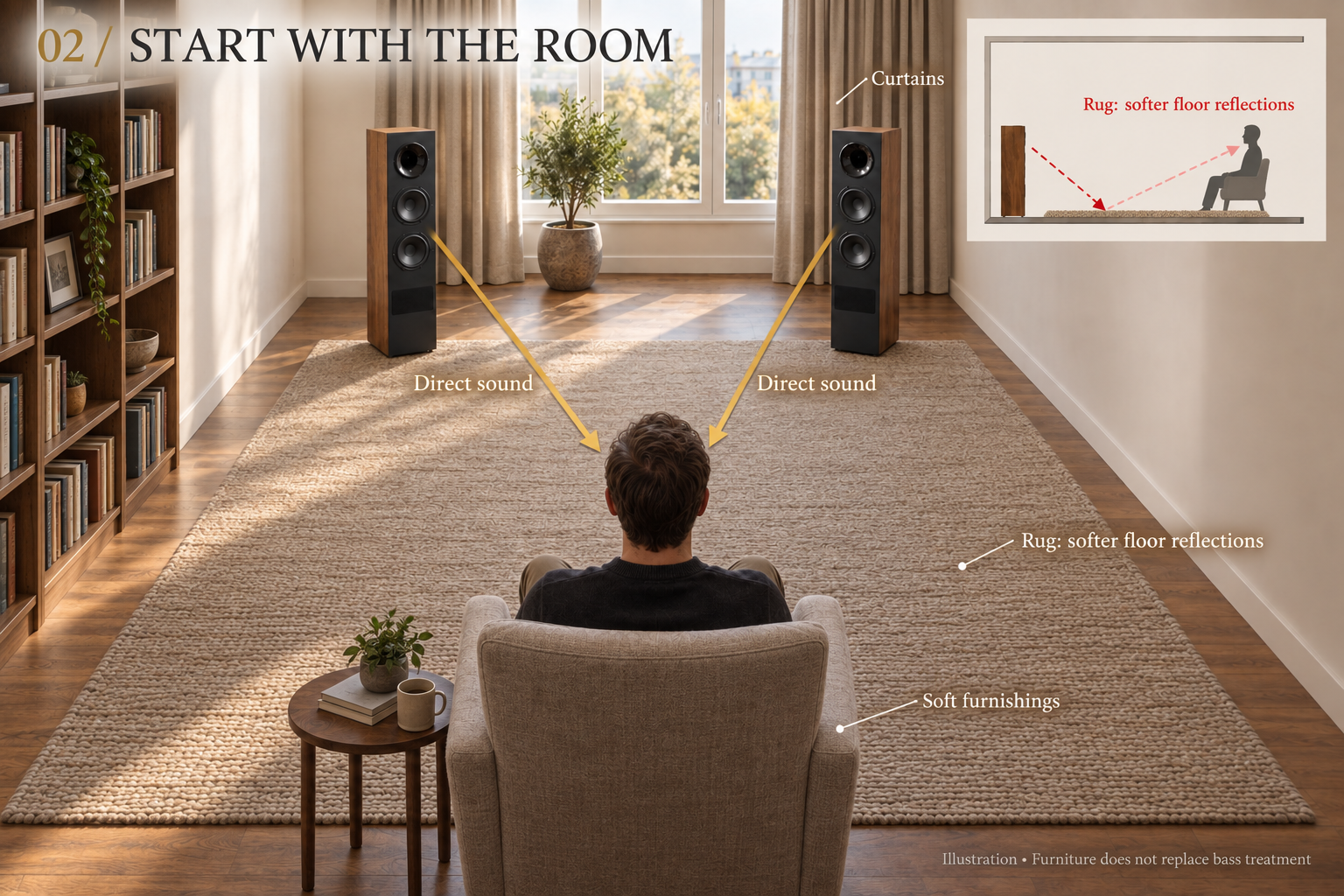
A rug between the speakers and your seat can soften some higher-frequency floor reflections. Heavy curtains and fabric upholstery can also reduce reflected energy, depending on their material and placement. They will not cure deep-bass problems.
If there is a large hard coffee table between you and the speakers, temporarily move it and compare. A bookcase breaks up a flat surface, but its scattering is not a substitute for a designed acoustic diffuser. Keep the left and right sides reasonably balanced rather than filling only one side with soft material.
Put panels where they have a job to do
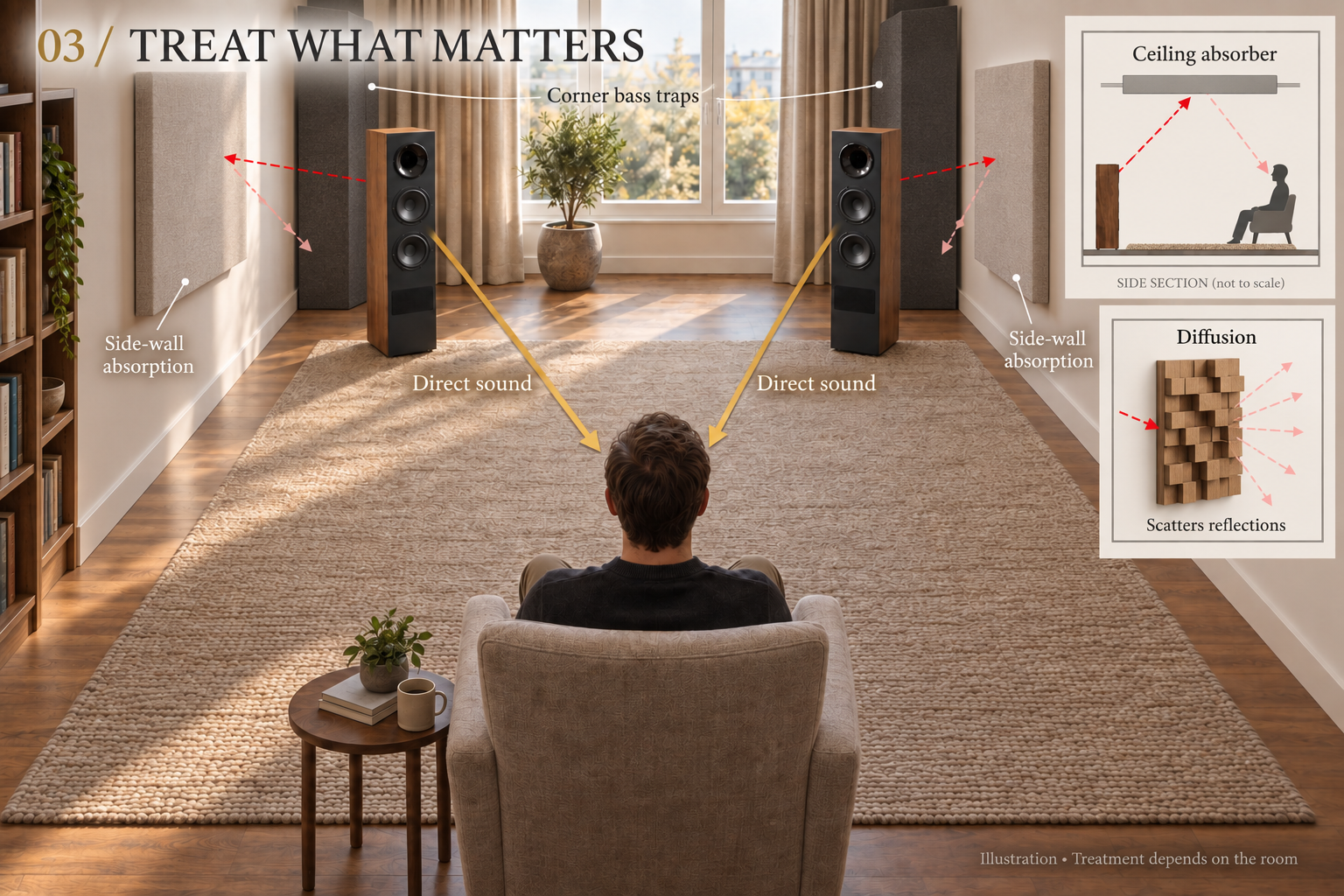
For side-wall reflections, try the mirror method. Stay in your listening position while someone moves a mirror along a wall. Wherever you can see a speaker’s tweeter is a candidate reflection point. Check both speakers on both walls. This identifies useful areas, not a complete treatment design.
A suitable broadband absorber at those points can reduce reflected energy. A properly specified ceiling absorber can address the ceiling path too; it needs secure mounting. Panel thickness, construction and any air gap determine its useful frequency range. Thin decorative foam should not be treated as a universal solution. Room-treatment principles.
Absorption and diffusion do different jobs. Absorbers reduce energy; diffusers redistribute reflected sound across directions. A diffuser may help preserve a sense of space, but it must suit the frequency range and distance to the listener. A wall or ceiling diffuser is not automatically the right choice in a small room. Absorption and diffusion.
Give bass its own attention
When one bass note hangs in the room while another almost disappears, turning down all the bass is a blunt fix. Room modes and boundary interactions affect different notes differently.
Begin with speaker and seat placement. If problems remain, bass traps can help control low-frequency decay within their working range. These may be substantial porous absorbers or devices tuned to particular frequencies. Corners are common locations, but the appropriate design and placement depend on the problem. A rug or thin wall panel cannot do the same job. Measurements are useful before committing to extensive treatment. Bass-trap types and limitations.
A listening exercise for this evening
Choose a short vocal passage and a bass line you know well. Keep the volume unchanged. Mark the original positions, change one thing, and replay the same passage. Compare with the original before making the next adjustment.
Listen for a voice that stays in place and bass notes you can follow individually. Stop when the music becomes easier to enjoy, not simply louder or brighter.
I want the loudspeaker to bring you closer to the recording. Giving it a thoughtful place in your room is part of that work.
Let’s talk about your room
Tell us about your room, current system and listening position. We can discuss where to begin.
AI-generated educational illustrations based on Reality Pro Walnut product imagery. Sound paths and treatment positions are schematic, not acoustic measurements or installation plans.